Medicare Enrollment Periods and Late Penalties
When to sign up for Medicare at 65, what happens if you're still working, and how to avoid the Part B and Part D penalties that can last for life.
Updated November 11, 2026 · Examined Life
Medicare has a handful of enrollment windows, and missing the first one can cost you a penalty for as long as you have coverage. Here's how they fit together.
Your Initial Enrollment Period
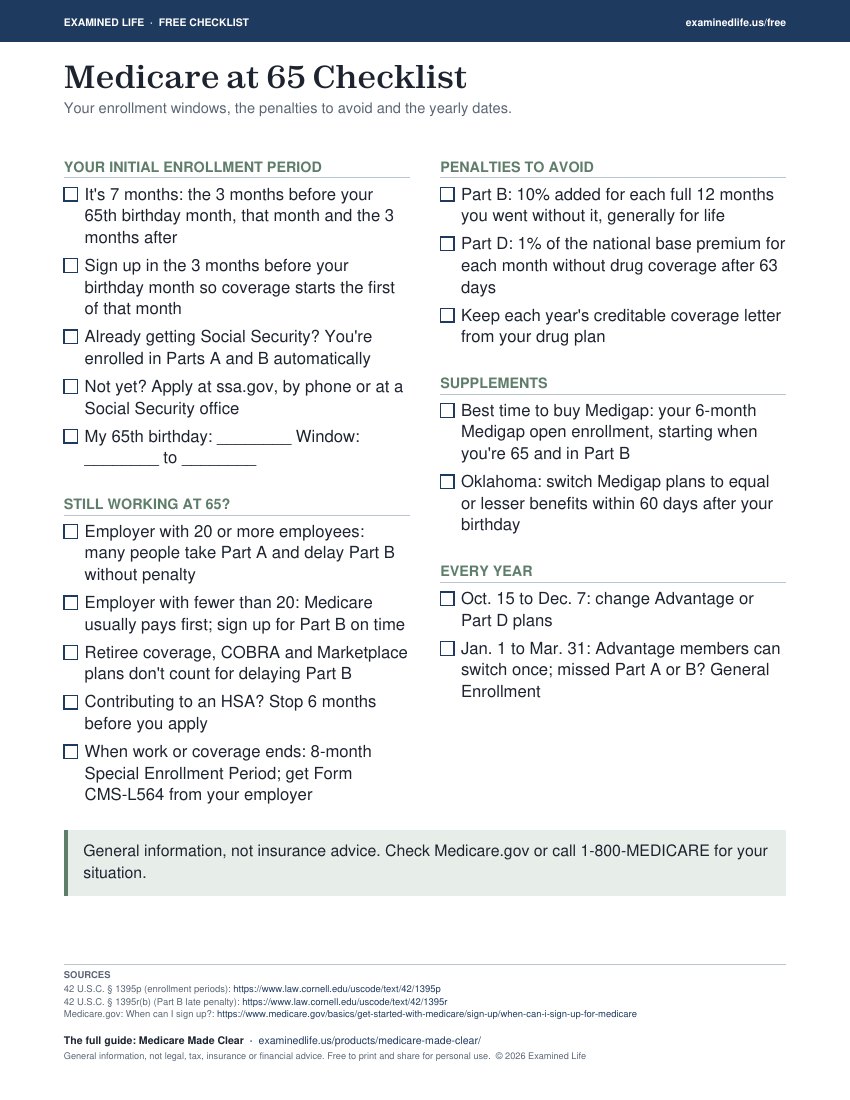
It's seven months long: the three months before the month you turn 65, your birthday month, and the three months after. Sign up in the three months before your birthday month so coverage starts on the first day of that month. If you already get Social Security, you're enrolled in Parts A and B automatically. If not, apply through Social Security. You can start Medicare at 65 without claiming Social Security.
If you're still working
| Your situation | What it usually means |
|---|---|
| You or your spouse are actively working; employer has 20 or more employees | The employer plan pays first. Many people take premium-free Part A and delay Part B without penalty. |
| Employer has fewer than 20 employees | Medicare usually pays first. Sign up for Part B on time. |
| Retiree coverage, COBRA or Marketplace coverage | None of these count for delaying Part B. Enroll during your Initial Enrollment Period. |
| You contribute to a Health Savings Account | Stop contributions six months before you apply, because Part A can be backdated up to six months. |
When employment or employer coverage ends, whichever comes first, you have an eight-month Special Enrollment Period for Part B. Your employer completes Form CMS-L564 to show your coverage. Don't wait for COBRA to run out.
The penalties
- Part B: 10% added to your premium for each full 12-month period you could have had Part B but didn't, without qualifying coverage. It generally lasts as long as you have Part B.
- Part D: 1% of the national base premium ($38.99 in 2026) for each month you went 63 days or more without creditable drug coverage. It lasts as long as you have drug coverage.
- Keep the yearly letters from employer drug plans saying whether coverage is creditable. They're your proof.
The yearly dates
| Period | Dates | What you can do |
|---|---|---|
| Open Enrollment | Oct. 15 to Dec. 7 | Change Advantage or Part D plans, or move between Original Medicare and Advantage |
| Medicare Advantage Open Enrollment | Jan. 1 to Mar. 31 | Advantage members can switch once |
| General Enrollment | Jan. 1 to Mar. 31 | Sign up for Part A or B if you missed your window; penalties may apply |
Oklahoma residents: since September 1, 2023, Oklahoma's birthday rule lets you switch Medigap plans to one with equal or lesser benefits in the 60 days after your birthday, without health questions.
The law behind this
- 42 U.S.C. § 1395pEnrollment periods, including the Part B special enrollment period.
- 42 U.S.C. § 1395r(b)Part B late-enrollment premium increase.
- 42 U.S.C. § 1395w-113(b)Part D late-enrollment penalty.
- OAC 365:10-5-129Oklahoma's Medicare supplement birthday rule.
Common questions
Do I have to sign up for Medicare if I'm still working at 65?
Not always. With coverage from your or your spouse's current employment at an employer with 20 or more employees, many people delay Part B without penalty. Smaller employers usually expect Medicare to pay first.
Is the Part B penalty permanent?
It generally lasts as long as you have Part B.
General information, not legal, tax or financial advice. Laws, fees and deadlines change; confirm anything time-sensitive with the agency, court or a professional.