Are You Responsible for a Parent's Debt After They Die?
Who pays a loved one's debts after death, when family members can be on the hook, and what debt collectors can and can't say.
Updated November 11, 2026 · Examined Life
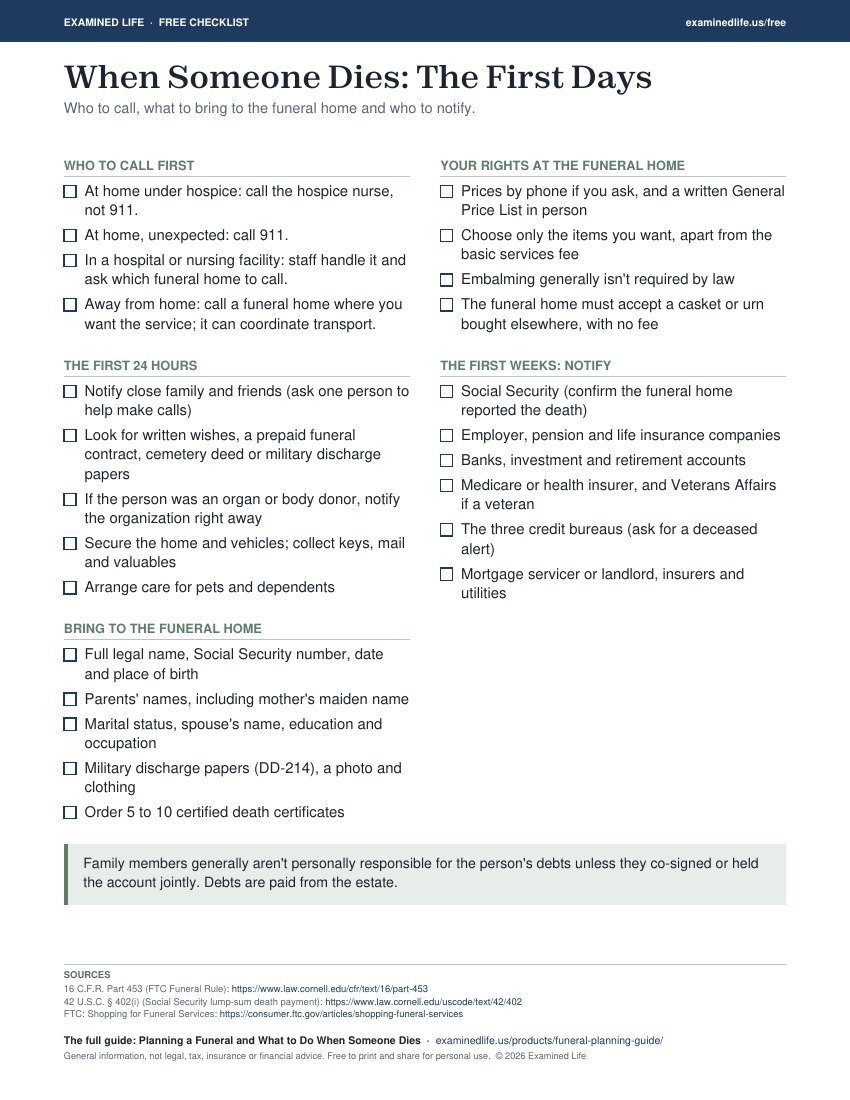
Usually not. Debts are paid from the estate, the property the person left behind. Family members generally aren't personally responsible unless they took on the debt themselves.
When you could owe it
- You co-signed the loan or card.
- You were a joint account holder, not just an authorized user.
- You're a surviving spouse in a state where certain debts are shared, or another law makes you responsible.
- You're the personal representative and distribute property before paying valid claims.
How estates pay debts
- The personal representative gathers the assets and gives notice to creditors.
- Creditors present claims by the deadline in the notice. Late claims are generally barred.
- Valid claims are paid in the order state law sets, before anything goes to heirs.
- If the estate runs out, remaining unsecured debts generally go unpaid. Heirs don't make up the difference.
Assets that pass outside probate, such as life insurance with a named beneficiary, often aren't available to general creditors, but rules vary by state and by asset. Property passed by a transfer on death deed in Texas, for example, can be reached for estate debts if the estate is short.
Dealing with collectors
- A debt collector may contact the personal representative to discuss the debt.
- Collectors may not mislead you about whether you personally owe the debt.
- Don't pay a debt from your own money just because a collector calls. Ask for the details in writing and refer it to the personal representative.
Send a death certificate to the three credit bureaus and ask them to add a deceased alert to the file. It helps prevent identity theft using the person's name.
The law behind this
- 15 U.S.C. § 1692eFair Debt Collection Practices Act: false or misleading representations.
- 12 C.F.R. § 1006.6(a)(4)Regulation F: collectors may communicate with the estate's representative.
- Tex. Est. Code § 114.104Texas TOD property and estate creditors.
- FTC: Debts and Deceased RelativesThe FTC's consumer guide.
Common questions
Do children inherit their parents' debt?
Generally no. Debts are paid from the estate. Children are responsible only if they co-signed, held the account jointly or another law applies.
Can a collector call me about my mother's debt?
A collector may contact the personal representative of the estate, but may not mislead you about whether you personally owe it.
General information, not legal, tax or financial advice. Laws, fees and deadlines change; confirm anything time-sensitive with the agency, court or a professional.