How to Freeze Your Credit at All Three Bureaus
A credit freeze is free, takes minutes and blocks most new accounts in your name. Here's how it works, how fast it must happen and how it differs from a fraud alert.
Updated November 11, 2026 · Examined Life
A security freeze, usually called a credit freeze, blocks access to your credit report for most new credit. Because lenders can't see your report, a thief can't easily open a card or loan in your name. Federal law makes freezes free at every bureau, in every state.
Freeze at all three
Each of the three nationwide credit bureaus, Equifax, Experian and TransUnion, keeps its own file, so you place a freeze with each one separately, online or by phone. Save the PIN or account login each bureau gives you; you'll need it to lift the freeze.
- How fast: a freeze requested online or by phone must be in place within one business day.
- Lifting it: when you apply for credit, you can lift the freeze temporarily. A lift requested online or by phone must happen within one hour.
- Children: a parent or guardian can freeze the file of a child under 16, even if the child has no credit history yet.
- How long: a freeze stays in place until you remove it.
Freeze or fraud alert?
| What it does | How long | Cost | |
|---|---|---|---|
| Security freeze | Blocks access to your report for most new credit | Until you remove it | Free |
| Initial fraud alert | Lenders must take reasonable steps to verify it's you. Contact one bureau and it notifies the other two. | 1 year, renewable | Free |
| Extended fraud alert | Same, plus removal from prescreened offers for 5 years. Requires an identity theft report. | 7 years | Free |
A freeze is the stronger protection. A fraud alert lets lenders see your report but asks them to verify your identity first. Many people use both after a breach.
Other files worth freezing
Some specialty reporting companies also accept freezes, including ChexSystems (used for bank accounts), NCTUE (used for phone and utility accounts) and Innovis. These don't replace the big three, but they close other doors.
If someone already used your identity
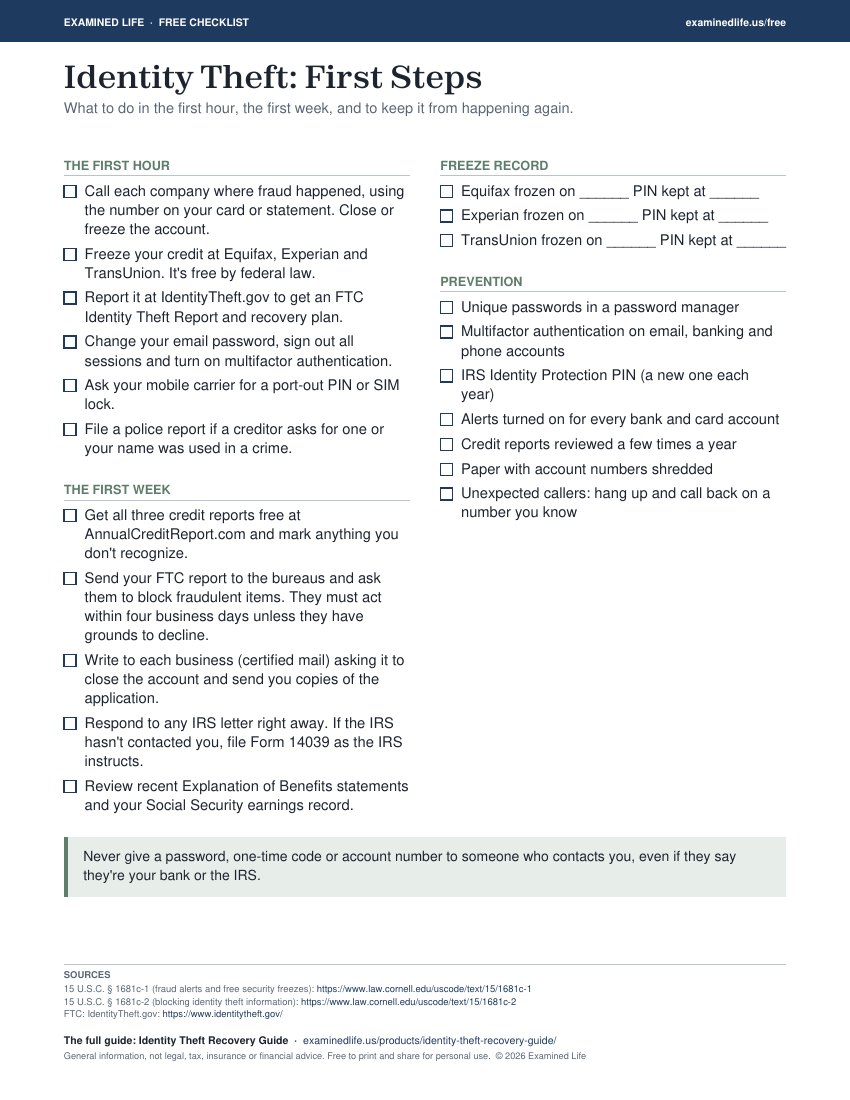
- Call the companies where the fraud happened and close or freeze those accounts.
- Freeze your credit at all three bureaus.
- Report it at IdentityTheft.gov to get an FTC Identity Theft Report and a recovery plan.
- Get your free reports at AnnualCreditReport.com and dispute anything you don't recognize. With an identity theft report, the bureau must block the fraudulent items within four business days unless it has grounds to decline.
The law behind this
- 15 U.S.C. § 1681c-1Fraud alerts, active duty alerts and free security freezes, including for minors.
- 15 U.S.C. § 1681c-2Blocking information that results from identity theft.
Common questions
Does a credit freeze hurt my credit score?
No. A freeze controls who can see your report; it doesn't change your score or your existing accounts.
Can I still use my credit cards with a freeze?
Yes. Existing accounts keep working. The freeze blocks most new credit applications until you lift it.
General information, not legal, tax or financial advice. Laws, fees and deadlines change; confirm anything time-sensitive with the agency, court or a professional.